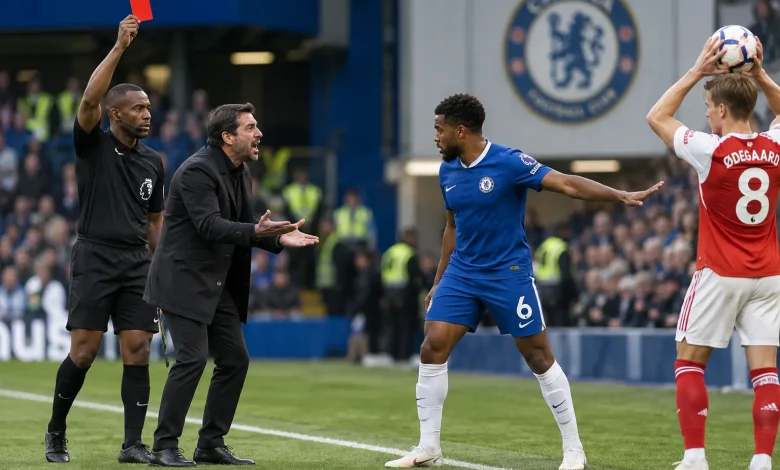
An unusual incident occurred on a referee where a defender was warned for getting too close to the touchline and then deliberately blocked a throw-in after.
The incident began with a throw-in; as the defender headed towards the touchline the referee advised him to retreat. When the throw-in was eventually taken the defender headed towards the touchline once more and blocked the ball.
The referee stopped the action and issued the defender with a yellow card.
The situation became even more unusual when the manager appeared to express disagreement with the assistant referee and left the technical area. According to the Laws of the Game, to exit the technical area in order to express disapproval of a match official can be considered a send-off offence.
Why was the defender given a penalty?
The most important aspect of the incident is the code of rules pertaining to throw-ins.
When a player is defending a throw-in they must not unfairly distract or obstruct the player taking it; this involves moving to within two metres of the spot on the touchline at which the throw-in is being taken.
The defender had already been instructed by the referee to move away from the touchline; but when the throw was taken he returned towards the ball and interfered with it.
The ball was in play when the defender blocked it since the throw-in had already occurred.
That distinction is crucial.
Why was the free kick given indirectly?



After the ball has been returned to play from the throw-in, the offensive team are not dealt with by simply retaking the throw.
The referee has the authority to penalise the player should he or she unfairly distract or obstruct the thrower.
The restart in this case is an indirect free kick to be taken from the spot where the defender touched the ball, provided that the normal requirements of the Laws of the Game are satisfied.
If the player had committed the offence before the throw-in had been taken, the referee would have halted the restart, given her a warning and asked that the throw-in be retaken.
What makes the incident so interesting is the difference between the state before the ball begins play and after.
What concerning the manager’s red card?
The manager’s reaction led to another disciplinary matter.
When the defender was cautions the manager left the technical area and obviously expressed his disapproval of the assistant referee.
Team officials may leave the technical area in some cases, but if they intentionally do so in order to confront or show dissent towards a match official a red card will follow.
The referee therefore had two separate incidents to deal with:
The act of the defender obstructing the throw-in.
The manner in which the manager treated the match official.
Was the referee’s decision the right one?
The referee’s decisions are in line with the relevant Laws of the Game in the light of the sequence described.
The defender had been told to move away from the touchline but instead headed back towards the throw-in and got in the way of the ball after it had entered play.
It means that a restart is now given as an indirect free kick rather than a retaken throw-in.
The manager’s behaviour is also a separate disciplinary issue, and deliberately exiting the technical area with the intention of showing disapproval of an official is enough for a direct red card.
What at first seems to be an ordinary throw-in actually becomes a complex sequence comprising player positioning, interference with a restart, disciplinary action and technical-area misconduct.
Editorial Note
The explanation is based on the incident and the way it has been interpreted in the source material, and finally it is up to the match officials what refereeing decisions are made, taking into account the player’s actions, the timing and the intent.
Source
Source: The information regarding the match incident and the refereeing has been provided for publication.