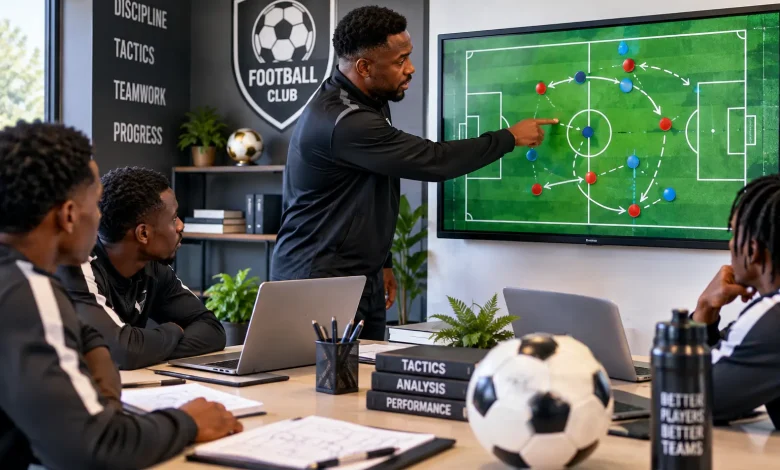
Watching football and analysing football are quite different things.
When watching a match you might pick up on who scores, misses, has a good game etc. But a deeper look allows you to understand why a team is creating chances, why they are struggling to play out and what the players are doing without the ball.
A good structure to break down a match can be split up into four main phases (in possession, out of possession, attacking transition and defensive transition) with set pieces studied separately as well.
This first section focuses on what happens when the team has the ball.
Start with the Build-up
The first part to study during a match is the build-up, and what a team does when they have possession in their own half.
Don’t focus too much on the formation they’ve written on the team sheet, but watch the positions they actually take up.
Are the centre-backs spreading out? Is a midfielder dropping between them? Are the fullbacks playing deep or getting up? Is the goalkeeper coming out to be an additional passing option?
All of these things can give you a good idea about what they intend on doing with the ball.
Many teams will look to play short passes in the build-up, but not simply for the sake of it. They may be trying to draw the opposition closer to the ball in order to create space elsewhere.
A typical example would be to be patient between their defenders and goalkeeper while the opposition’s forwards are sucked further up the pitch. This might create a midfielder to come in behind the press.



That’s a good one to pick up.
What is the team trying to do with the ball?
Look at the Numbers
One thing you will notice during the build-up is that teams like to create an extra man against the first press.
If the opposition is sending one forward to press, they might use two players to build up around that press. If the opposition is sending two forwards to press, they might build up with a first line of three.
This isn’t necessarily about having extra players. It’s about another passing option and being able to move the ball around and beyond the first wave of pressure.
However, not every team is going to follow this exact pattern. The key thing is to watch what they’re actually doing rather than trying to fit it into a certain mould.
Then Watch How the Ball Goes Through Midfield
So now the team has got out of their press, the question is how they progress into the attacking third.
This is where it’s worth looking out for any line breaking balls, and players moving out of position away from the ball.
A midfielder coming in between the opposition’s midfield and defence, a winger coming inside to create an extra man centrally, a fullback stretching the defensive line forwards are all good signs of progression into the attacking third.
Sometimes the ball goes through the middle, sometimes it goes around the outside, and sometimes a team simply plays over the midfield with a further pass.
So when looking at a team, you might want to consider;
- Do they like to go around?
- Through?
- Or over?
There is no rule that says a team has to pick just one, and indeed most teams will vary based on how the opposition is defending.
Pay Attention to Players Between the Lines
One of the simplest ways to spot attacking intent is to watch for what happens in between the opposition’s midfield and defence.
A player receiving there has the opportunity to turn and face the goal.
But it’s what happened before he received the ball which can be interesting.
Maybe a striker dropped towards the ball, dragging a centre-back forward.
Perhaps a winger came inside, occupying a defender in the process.
Perhaps a midfielder ran through the backline at just the right time.
These movements can link up, and a player is not always moving just to receive the ball. Sometimes they’re doing it to create space for someone else. That’s a good habit to pick up when analysing football.
Look for Rotations
Players are not always in their starting positions.
A winger may drift into the middle while his fullback runs outside him. A midfielder may move towards the wing, with another midfielder moving into the central position.
These rotations can cause confusion for defenders.
When you see this happening, you don’t want to simply describe it. Try to explain why it happened.
Was it to create a 2v1? To pull someone out? Open up a passing lane? Was someone trying to attack the space behind the defence?
The answer to these questions is key in understanding the team’s tactic.
The Final Third is Where the Plan is Revealed
Once the ball has got into the attacking third, watch how the team tries to create their final chance.
Some teams like to combine short passes around the box, others attack quickly from the flanks and throw crosses into the box. You might see a fullback constantly overlapping a winger, and another team will like to keep their fullbacks deeper, asking the wingers to attack the space inside instead.
There are a lot of things you can look for.
Look out for repetitions of these things. Does the winger keep cutting inside? Does the fullback always overlap? Does the midfielder always arrive late at the edge of the box? Does the striker always move towards the post? Do these attackers always look for cutbacks instead of high crosses? This one thing might not tell you much, but if you see the same thing occur several times during a match it will almost certainly be part of the plan.
Don’t Forget the Players Themselves
A team’s tactics are also affected by the qualities of the players involved.
A fast winger can force a fullback into moving into a new position, a striker comfortable dropping deep can cause problems for centre-backs and a midfielder with great passing range can allow the team to attack from further up the pitch.
That is why two teams with similar formations can look totally different.
The formation gives you the starting point, but what the players are doing and their qualities inform what the team is actually trying to do.
A Simple Way to Watch a Match
If you are new to analysis and don’t want to take on too much initially, pick one team and watch its possession.
First, observe their shape when the goalkeeper or centre-backs have the ball, then how the midfielders are positioned. Next, look at how the team gets into the final third. Finally, see what the attackers do once they have the ball. After a few attacks, you should start seeing patterns.
You might notice that the right fullback always moves forward when the right winger cuts inside. Or the striker always drops deep to open a space for a midfielder. These repeated actions are the ones you want to pick up on.
The Biggest Mistake: Watching Only the Ball
This is probably the hardest habit to break.
When the ball is with the centre-back, it’s natural to watch it. But some of the most interesting things happen elsewhere.
Watch the midfielder.
Look at the winger.
What is the striker doing?
Is a defender getting pulled out of position?
Sometimes the pass that breaks a defensive line is only possible because of an action that happened several seconds ago, and away from the ball.
What Should You Write Down?
By the end of the possession phase you should be able to answer a few basic questions.
Build-up: How are they structuring themselves to deal with pressure?
Progression: How do they get through the midfield and into the attacking third?
Final third: How do they create chances?
Player movements: Which movements do they repeat?
Individual qualities: Which players are affecting their attacking approach?
You don’t need complicated terminology to produce good analysis.
If you can explain what happened, why it happened and whether the team repeated it, you’re already moving beyond simply watching the game.
The next step is to analyse what happens when the same team doesn’t have the ball. That is when you start to look at pressing, the defensive shape, tracking runners, and how a team tries to stop their opponent progressing.